
One of the first questions people ask when considering bariatric surgery is, “How much weight will I actually lose?”
While the answer depends on many factors—including the type of procedure, starting weight, age, and commitment to lifestyle changes—credible studies offer a range of expected results.
This post explores how weight loss occurs after surgery, what typical results look like for different procedures, and how to set realistic expectations.
How Bariatric Surgery Promotes Weight Loss
Bariatric procedures work by altering how much food your stomach holds and, in some cases, how much you absorb.
Restrictive operations (like sleeve gastrectomy) remove a large portion of the stomach, creating a banana‑shaped pouch that limits food intake and reduces hunger‑inducing hormones.
Malabsorptive procedures (like gastric bypass and duodenal switch) also reroute or bypass part of the small intestine, limiting calorie absorption.
These changes jump‑start weight loss but must be paired with dietary discipline, physical activity and psychological support for long‑term success.
Typical Weight Loss by Procedure
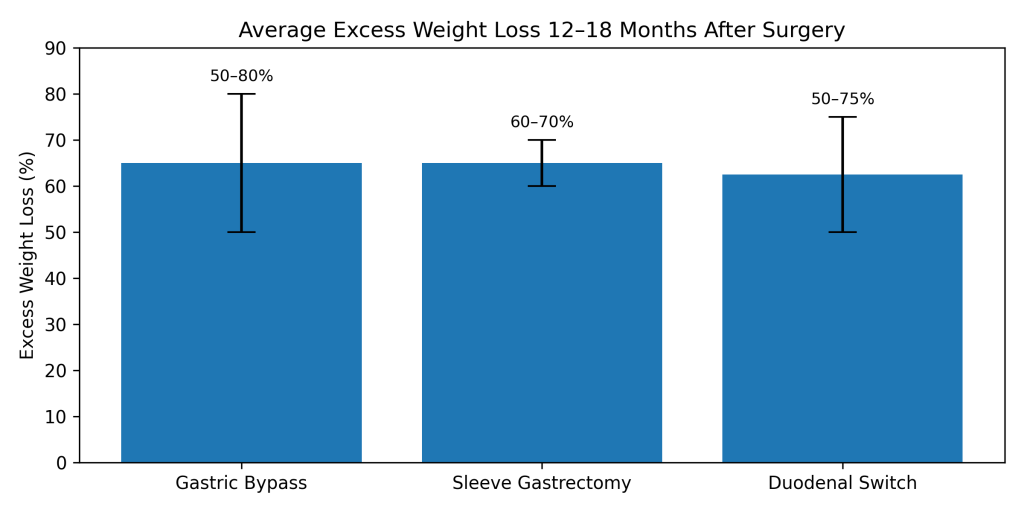
Results vary widely from person to person, but published guidelines provide approximate ranges for excess weight loss (EWL)—the percentage of weight you lose above your ideal weight.
| Procedure | Expected Excess Weight Loss (12–18 months) | Evidence |
|---|---|---|
| Gastric bypass (Roux‑en‑Y) | Most patients lose 50–65% of their excess weight within 1–2 years. Some programs report 60–80% EWL at 12–18 months, averaging about 1–2 lb (0.5–1 kg) per week. Patients who maintain healthy habits can sustain 50% EWL or more long term. | Columbia University Irving Medical Center; UPMC |
| Sleeve gastrectomy | Sleeve gastrectomy can result in ~60% of excess weight lost within two years. UPMC notes that patients generally lose 60–70% EWL at a slower, steadier pace over 12–18 months. | Mayo Clinic; UPMC |
| Duodenal switch (traditional or SADI‑S) | Weight loss is more gradual initially. Cleveland Clinic reports losing ~30% of excess weight in the first three months, 50–75% by one year, with weight‑loss peaking between 12 and 18 months. | Cleveland Clinic |
| Adjustable gastric band | Less common today. Studies suggest 40–50% EWL over three years, and results depend heavily on band adjustments. | UPMC, ASMBS |
What About Total Body Weight Loss?
Many people prefer to think in terms of total body weight lost rather than excess weight. Long‑term data from Cleveland Clinic show that people who undergo metabolic surgery lose about 21.6 % of their body weight over 10 years. In comparison, patients who rely solely on GLP‑1 medications average 6.8 % weight loss.
Weight‑Loss Timeline: What to Expect
Weight loss is not linear. It typically occurs in phases:
- Rapid phase (0–3 months): Immediately after surgery, your intake is limited to liquids and purées. Cleveland Clinic notes that duodenal switch patients lose about 30 % of excess weight during this period. For other procedures, you may lose two to four pounds (0.9–1.8 kg) per week.
- Steady phase (3–6 months): As you transition to soft and solid foods, weight loss continues but slows to one to two pounds per week. The ASMBS notes that patients often lose 60 % of excess weight by six months.
- Consolidation (6–12 months): Most people reach 60–80 % EWL by one year. The rate of loss tapers as your body adapts.
- Plateau and maintenance (12 months and beyond): Weight loss peaks between 12 and 18 months. Maintaining or increasing activity and following your diet prevent weight regain. Studies show that after five years, patients maintain about 50 % of their excess weight loss.
Tip: Focus on building muscle and improving fitness during the consolidation phase. Resistance training not only boosts metabolism but also improves body composition and prevents sagging skin.
Factors That Influence Success
Your procedure is only part of the equation. Long‑term success hinges on:
- Adherence to diet and supplementation: Eating protein‑rich meals, avoiding sugar and high‑fat foods, taking prescribed vitamins and minerals, and staying hydrated.
- Regular physical activity: Starting with walking and gradually increasing to cardiovascular and strength training boosts weight loss and preserves muscle.
- Mental health and support: Emotional eating, stress and lack of support can lead to grazing and high‑calorie snacking. The Cleveland Clinic points out that habits like binge eating and grazing contribute to weight regain. Staying connected with your bariatric team, attending support groups and addressing emotional triggers can prevent setbacks.
- Follow‑up care: Regular appointments with your surgical team help catch nutritional deficiencies, vitamin shortages or behavioral issues early. The ASMBS emphasises that most patients who maintain follow‑up visits keep off a significant amount of weight.
Understanding Weight Regain
Some degree of weight regain is normal. After the first year, metabolism stabilizes and appetite returns. Factors that contribute to regain include:
- Large portion sizes or grazing throughout the day
- Frequent alcohol or high‑calorie beverages
- Not prioritising protein and fiber
- Sedentary lifestyle
- Unaddressed emotional or psychological issues
The good news? Studies show that with good habits, even modest weight regain doesn’t erase the surgery’s benefits. Quality of life, blood sugar control and cardiovascular risk factors often remain much improved.
Call‑out: Celebrate non‑scale victories—like improved mobility, better sleep and higher energy. These often happen before major changes on the scale and can motivate you to keep going.
Setting Realistic Expectations
Every journey is unique. Some patients may lose more (or less) than average. Your starting BMI, metabolic health, age, hormones and adherence to post‑surgery recommendations all influence results. Remember that the goal of bariatric surgery is health improvement, not perfection on the scale. Achieving a 5–10 % reduction in body weight dramatically lowers risk for type 2 diabetes and heart disease; bariatric surgery usually exceeds that by a wide margin.
How Novara Supports Your Journey
At Novara Academy, we help you navigate this complex journey. Our Life After: Next Chapter program provides guidance on nutrition, exercise, mindset and relapse prevention. Once you reach a stable weight, our Evolve: Continuing the Journey program helps you maintain momentum, build strength and redefine your relationship with food and your body. Whether you lose 20 % or 70 % of your excess weight, our coaches will celebrate your progress and help you set sustainable goals.
Ready to take the next step? Reach out to our team to learn more about our programs and schedule a consultation. You deserve to feel strong, confident and in control of your health.
Disclaimer: The information in this article is for educational purposes only and does not replace professional medical advice. Always consult your healthcare provider regarding your individual circumstances.
